 |
 |
|
|
Stewards & Custodians is a newsletter for those investing in the preservation of Black history at a pivotal moment. As AI emerges as a dominant technology, we must contribute accurate information about our culture, even as nations begin returning what was taken. We track the urgency of this work and the financial opportunity as the global diaspora unites to reclaim and protect its own cultural legacy. |
|
 |
The Freedom to Remember
Lonnie Bunch built the National Museum of African American History and Culture from the ground up as its founding executive director, then became the first Black Secretary of the Smithsonian, the institution's highest office, in its 173-year history. This month, he announced he's stepping down, amid mounting pressure from the Trump administration over how the Smithsonian tells America's story.
Institutions can be pressured. Federal funding can be threatened. Leadership can change. What Bunch built at NMAAHC still stands, but his departure is a reminder that public institutions preserving Black history operate at the mercy of whoever holds power. The Obsidian Collection exists because that history also needs a home that answers to no administration. As the largest privately held Black archive, we're not a substitute for institutions like the Smithsonian. We're insurance for when they're under pressure.
|
|
|
| Read More About Bunch's Departure → |
|
|
 |
The AI Investment Opportunity Beyond Infrastructure
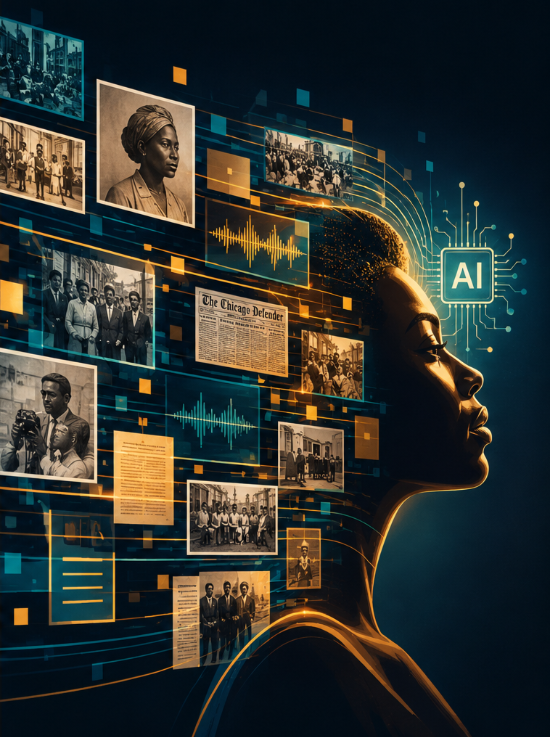
AI is attracting unprecedented levels of private capital. Goldman Sachs estimates that global AI capital expenditures could reach $765 billion in 2026, with annual spending projected to reach $1.6 trillion by 2031. Goldman Sachs Research
But the opportunity is bigger than infrastructure.
AI systems require more than computing power. They require high quality, differentiated data.
That is where The Obsidian Collection sees an opportunity.
Black history remains significantly underrepresented in the digital datasets that inform technology, media and AI. Photographs, newspapers, documents, oral histories and other primary sources have been dispersed across private collections and institutions, often without the digitization, metadata, rights management or accessibility necessary for today's digital economy.
Obsidian is building that missing layer.
Our strategy combines preservation, digitization, technology and rights management to transform historically significant Black content into structured, discoverable and licensable digital assets.
We are not trying to compete with the billions being invested in AI infrastructure.
We are building the proprietary data opportunity that can make that infrastructure more valuable.
For investors, this creates an opportunity to participate in AI from a different position in the value chain, while helping ensure that Black history is represented in the technologies shaping the future.
The AI buildout is happening now. The opportunity to establish the data layer is happening now.
|
| Explore the Investment Opportunity |
|
|
|
|
|
|
An Inheritance, Shared
A Lifetime of Stewardship, Passed Forward
Some archives arrive through discovery. Others arrive through trust. Nathan McGill, grandson of Nathan K. McGill, the first African American to serve as Assistant Attorney General for the State of Illinois, is sharing his family's personal archive with The Obsidian Collection: hundreds of images and documents spanning the 1920s through the 1940s, capturing Black Chicago at its height.
Nathan K. McGill wasn't just a groundbreaking attorney. He was a business partner and confidant to Robert Abbott, publisher of the Chicago Defender, and moved in circles that included Duke Ellington and Ida B. Wells. The archive reflects that world in full: financial records, correspondence, property deeds, insurance papers and photographs, including several rare images of the family's custom-built Pierce Arrow sedan alongside the itemized service receipts, repair records and title that document its life in extraordinary detail.
Individually, these are receipts and letters. Together, they're a rare, granular window into two decades of Black achievement, wealth-building and influence rarely preserved with this much detail. At 77, Nathan McGill has spent a lifetime as steward of this history. We're grateful he chose to share that stewardship with us, and even more grateful for everyone who will get to learn from it.
|
|
|
The Obsidian Library |
|
|
The Obsidian Library keeps growing, one generous donation at a time. Recently, actor and author Michael Fosberg gave us 128 art and coffee table books inherited from his family, spanning Black photography, art, architecture, music, and politics. Every book in our library exists because someone chose to share it, and every one is made available for research and educational purposes at no cost to the reader. |
|
| Learn about these books |
|
|
|
Together, we are not simply preserving media, we are protecting the cultural record of a people. Thank you for standing with The Obsidian Collection in this work. The archive speaks. We are listening. |
|
|
|
|
|
|
|
|


